Difficult Things
- jujutsuweasel
- Dec 29, 2025
- 8 min read
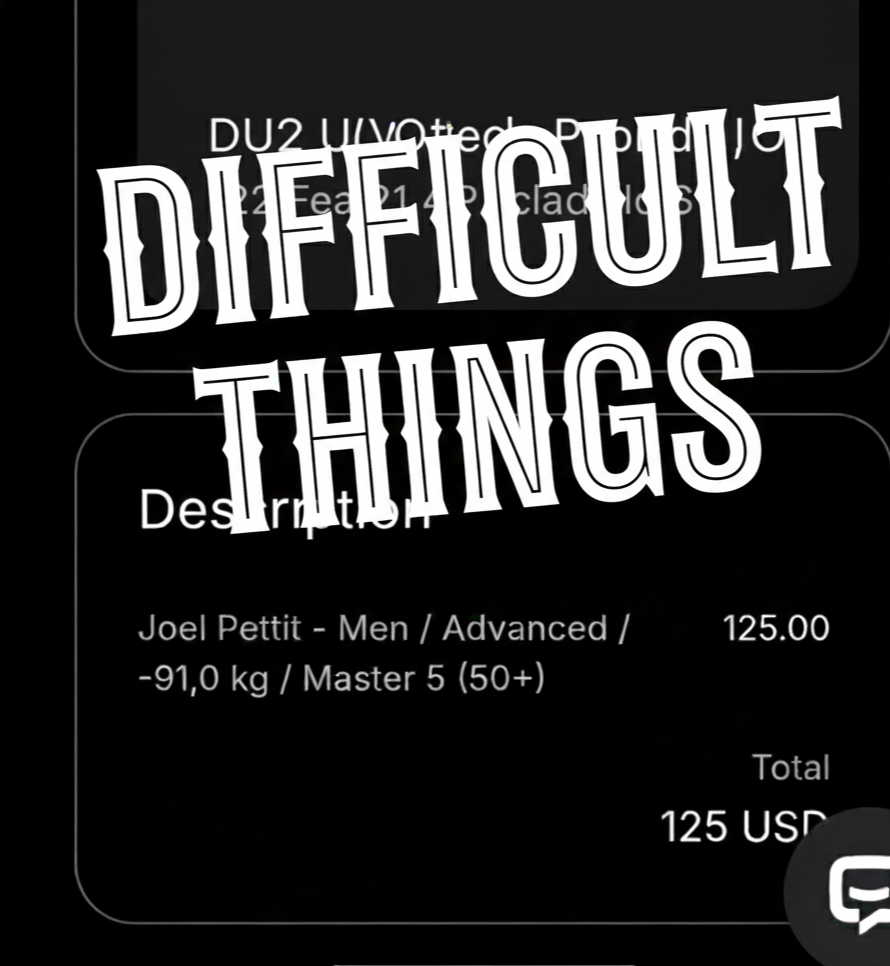
Sometimes I need to make myself do difficult things. I suppose that it’s a way to focus myself and gain perspective in difficult seasons of life. So I decided to make myself do something difficult in my current difficult season. I decided to compete.
I’m signed up and everything. I’ve already paid for my admission, which I think pretty much obligates me to show up.
I went to my chiropractor yesterday and he asked me when the last time was I competed. I think it’s almost been ten years. My teammates have really been after me to get back on the competition trail. My coach—and one of my best friends—knows me well. He knows that in my difficult seasons this is a way to refocus myself, to find something difficult that I have some control over.
So I’m going to compete. I’m going to go see if I still have that kind of edge.
Of course, the moment I registered all the questions began circling my hyper-stimulated brain. I’m not a young man anymore. I think calling myself rusty would be a compliment. I haven’t done this sort of thing for years. Can I still wrestle? Am I going to let my team down? Is my leg-lock game good enough to survive an ADCC event? How about my conditioning—am I in good enough shape to do this stuff again? How’s my weight?
Then the nerves start and I start playing all of the possibilities repeatedly in my mind. What kind of opponent(s) am I going to run into? What kind of game are they going to run at me? Am I really ready for this?
There is a ghost of a memory that lives in my mind, a ghost from the very first time I fought.
I was standing in line to grab a beer at the after-party. I thought fighters were supposed to go to the after-party, so I went. I didn’t know any better. It was the first time I had ever fought.
And it had not gone well.
I should never have been allowed to fight. I wasn’t ready. I wasn’t prepared. I hadn’t trained like I should have, but I didn’t know any better. I just wanted to test myself and see what I was capable of. My coach had wanted to give me a chance to test myself, but he was new at coaching fighters. So, I had ended up in the ring against a far more experienced opponent who had been properly trained.
It ended poorly for me—I think my loss set a new world record as one of worst losses on the books.
In the moments before my opponent and I fought I had fought him 100 times in my mind. I was going to fake—he was going to react. I was going to go out and throw a hard overhand right, then hit the ankle-pick. I was going to throw a flying knee to close the distance, then get the body-lock and take the fight to the ground. By the time I hit the ring I had fought that fight over and over again. When the bell rang, I did the dumbest thing possible. I charged him like a bull. He slipped and threw a punch, accidentally landing an elbow. Technically, that was an illegal blow, but it was over so fast there was nothing to argue about.
So, I found myself in line at the after party, thinking that was where I was supposed to go after the fights were over. Really, I just wanted to go home and nurse my shame.
Then the guy in front of me in line turned around. I recognized him immediately, because I had seen him fight on pay-per-view. I had seen him fight at the highest levels. I knew that he was an excellent fighter—one of the best in the world. My face turned a bit crimson when I realized that he recognized me. There was only one place that someone like him could recognize me from and that was from my humiliating loss.
“I saw your fight,” he said.
“Yeah,” I shrugged timidly. There hadn’t been much of a fight to see, but I guess he had seen what little of it there was.
“You weren’t ready,” he said. “Your team should have prepared you better. You tried to make the fight happen too fast. Every fight has a pace, and you need to sense that pace. You can’t go far beyond the pace, and you can’t lag behind it. You weren’t prepared. You didn’t know the pace of the fight, because every fight has its own pace.”
Every fight has its own pace.
I’m competing in a couple of months, and I could compete thousands of times in the arena of my own mind before ever stepping on the mats. I could stress myself out and wear myself down trying to play every possible scenario for every possible match between now and then. And, in the end, not one of them would occur as I anticipate. My efforts will have been wasted. I can’t anticipate the future. I can hope for it. I can prepare for it. But I can’t anticipate it.
I only recently learned that one of the most commonly used Hebrew words for hope (look, patiently, tarry, wait) is kaw-vaw'. This word for hope is based on another word, the word tik-vaw'. I’m not a linguist. I don’t speak ancient languages, so I can only explain this in the way that makes the most sense to me.
The word tik-vaw’, as an expression of hope—or as anticipation, or as expectation—is rooted in the same word that refers to a measuring tool. This measuring tool is a long chord, like an extended measuring tape. To perform its purpose properly the chord must be stretched to a point of tension. It must be extended.
And, for some reason, the idea of a hope full of tension spoke to me.
Because I am in a difficult season full of difficult things. And I want those difficult things to be over. I want the season to end. But I’m not in charge of when the season ends. I can’t even see the end of the season from where I am standing. It is a blurry and distant thing that I can only hope for—a thing that I can only stretch toward. And in that tension I find myself uncomfortable, but I also find myself strangely anticipatory. I don’t have a choice. I have to wait. I have to hope.
Wait for the LORD; be strong and courageous. Wait for the LORD. (Psalms 27:14)I could fight these fights over and over in my mind, exploring every possibility of victory or of defeat until I exhaust myself. I could seek the fastest way out or the slowest way out. Or I could just hope the fight would be over, already. I could hope that the tension would end.
But the hope requires a tension. The hope requires that I be stretched. Without the stress there is no actual hope. As much as I hate it, the hope of being at the end of difficult things is not mine to dictate. Sometimes, the hope requires that I remain in the tension.
I wait for Yahweh; I wait and put my hope in His word. (Psalms 130:5)
The hard part is learning to rest in the hope. My propensity is for worrying and stressing, for perseverating on every possible outcome . My instinct is to fix everything and look for the problems I can solve so that the tension will end. But the beauty of hope is in the tension. That is the place where God is waiting to greet me. He is waiting to prove Himself to me.
I waited patiently for the LORD, and He turned to me and heard my cry for help. (Psalms 40:1)
And so, in seasons of difficult things I have a tendency to seek out difficult things. I seek them out so that I can be taught how to hope—how to wait. I learn so many lessons when I choose to embrace difficult things. That’s why I give myself difficult things like they’re gifts.
On that day it will be said, “Look, this is our God; we have waited for Him, and He has saved us. This is the LORD; we have waited for Him. Let us rejoice and be glad in His salvation.” (Isaiah 25:9)
In my preparation for this difficult thing—this upcoming competition—I am going to try to teach myself how to hope properly. I am going find the lessons I can learn in this process. I am going to try to do this the right way, even if it’s hard.
(Isa 40:31) but those who trust in the LORD will renew their strength; they will soar on wings like eagles; they will run and not grow weary; they will walk and not faint.
I’m doing this training camp differently. I’ve been out of the competition game for a while, so I’m taking a step back from coaching. I’m going to be a student for the next several weeks. I’m letting the young guys organize the training camp. Figuratively (because this is a no-gi competition), I’m taking off my black belt. I’m surrendering my agency to the young guys. They’re in charge and I am not.
And I’m showing up.
I’m getting every repetition and every round I can. I will not let myself quit on myself. I’m not going to let myself be tired. I’m not allowed. One more round—there’s always one more round. I’m going to let myself be bad at things, and I’m going to work on the things I’m bad at. I’m going to let myself be placed in bad positions so that I can fight my way out of them. I’m letting the white belt sink that choke all the way in so that I can prove to myself that I can still fight out of it—sometimes I’m not going to be able to fight out of it, but that’s OK because I like naps.
While I’m waiting I’m going to do work. I’m going to keep hoping for victory, but I’m going to prepare all the same. Hope without preparation is nothing more than optimism. I’m not a natural optimist. My mind is too busy. So I’m going to do some work in the meantime so I don’t have to lean on optimism.
The LORD is good to those who wait for Him, to the person who seeks Him. (Lamentations 3:25)
Maybe by making myself do difficult things in a season of difficult things I can teach myself a few lessons. Actually, maybe I’ll allow myself to be taught lessons. Maybe a short-term difficult thing that happens on a date I know (February 21, 2026) will help me learn how to effectively hope for the difficult things that don’t end on dates. They end when they’re done, and I don’t know when that is.
Because difficult things do only last for a season, even if I don’t know when the season ends.
On that day it will be said, "Look, this is our God; we have waited for Him, and He has saved us. This is the LORD; we have waited for Him. Let us rejoice and be glad in His salvation." (Isaiah 25:9)


Comments